
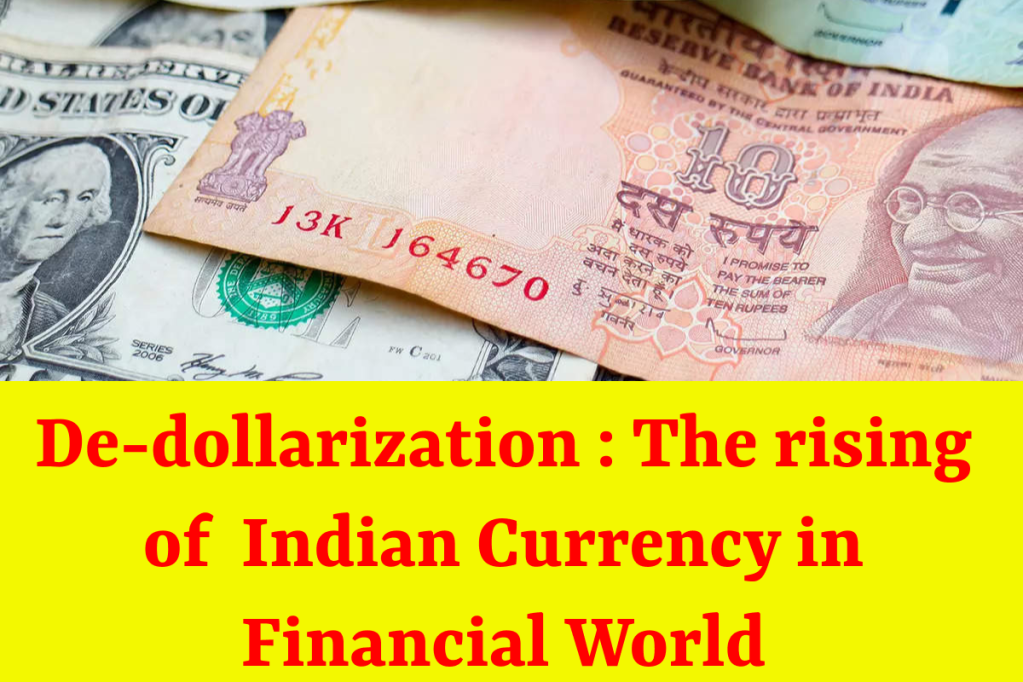
India and Russia are all ready to start conducting trade settlements in rupees rather than dollars. Indian exporters anticipate that shipments to Russia will be settled in rupees perhaps in coming weeks so that India may conduct business with Russia. It is a major issue to stop using dollars. In actuality, there will be more. It comes out that India will trade with other nations using their own currencies in addition to Russia. A number of countries are increasingly using the Indian rupee as a sought-after currency for trade agreements. Who are these nations who are interested in trading in rupees with India? Why are they trying to get rid of the dollar? And what advantages does India stand to gain from more nations choosing to trade in rupees?
Recently, there have been discussions on dedollarization. What does “dollarization” mean? It is an international movement to break the link between trade and the US currency. Currently, the dollar is used for both international trade settlements and purchases of oil globally. Therefore, the US has a firm hold over the world’s financial and economic systems. Many nations, such as China, Russia, Saudi Arabia and its Gulf allies, and Iran, wish to change that. Using the Indian rupee, for instance, as a step to lessen reliance on the dollar for bilateral trade between countries, governments are starting to take incremental efforts to decouple from the currency. Reuters reports that Tajikistan, Cuba, Luxembourg, and Sudan have started discussions with India on utilizing the rupee as payment for bilateral trade.
The Indian government wants to encourage nations with a shortage of dollars to settle bilateral trade in rupees. These are nations whose requests have not yet received approval from the Reserve Bank of India, the nation’s national bank. There are more nations to which the RBI has already granted permission to trade in rupees, including Sri Lanka, Russia, and Mauritius. International banks must accept special rupee accounts. They are referred to as vostro accounts. The central bank of India must give its approval before such accounts can be opened. 18 vostro accounts have already been opened by banks with permission from the RBI. 12 of these accounts are Russian, 5 are Sri Lankan, and 1 is Mauritius. Tajikistan, Cuba, Luxembourg, and Sudan are anticipated to open their own accounts soon as well, allowing for swift rupee transaction settlement.

Not only that. Significant West Asian nations like Saudi Arabia and the United Arab Emirates are in negotiations with India to start conducting bilateral commercial transactions in both the rupee and their own currencies. The central banks of India and the UAE are putting the finishing touches on a potential rupee dirham trade mechanism. In the meantime, discussions for a rupee real trade mechanism are taking place between Saudi Arabia and India. In fact, Saudi Arabia and the United Arab Emirates are looking for ways to reinvest Indian rupees they receive through trade deals in India. This is due to the fact that these nations sell more goods to India than they import from it. The extra rupees they make from trading with India must thus be spent. India has suggested that these rupee holdings be put into its government securities.
Now, why is it crucial to do bilateral trade with these nations using the rupee? Take the UAE as an example.
With a bilateral trade volume of $43.3 billion in 2020, this Gulf country is rank third in terms of trade volume behind the US and China. Who will follow the United States? Iran and China India’s fourth-largest trading partner is Saudi Arabia. The value of commerce between India and Saudi Arabia in the most recent fiscal year was approximately $42.8 billion, or consider Russia. This heavily sanctioned nation is scrambling to find new product suppliers. Recently, Russia provided a lengthy list of things it wanted from India, including everything from textiles to pharmaceutical medications to vehicle and airplane parts. India stands to earn greatly by exporting these commodities to Russia, and utilizing its own money in these transactions will support the value of the rupee. The flow of dollars out of India can be restricted by using the rupee in overseas transactions. India can instead store the secure money in its foreign exchange reserves. The rupee will strengthen versus the US dollar and continue to lose value as more people use it.
Do you anticipate the rupee being the next significant world reserve currency? Let us know what you think.
 Papier